Article updated on 13/08/26
What is IT Operations Management?
Understanding ITOM starts with its formal definition.
We’ll break down the reason by starting with the definition of ITOM and its relationship to ITSM.
IT Operations Management (ITOM) is defined by Axelos as:
“The function within an IT service provider that performs the daily activities needed to manage IT services and the supporting IT infrastructure. IT operations management includes IT operations control and facilities management.“
In practice, ITOM encompasses the administrative procedures that manage all components of an organization’s IT infrastructure. ITOM can be integrated into an ITSM platform, and can include any of the processes covered in the Technical Management Practices in ITIL 4.
A few functions of ITOM include:
-
Network Infrastructure Management
-
Server and Device Management
-
Computer Operations: manages the day-to-day running of IT systems, including batch processing, job scheduling, and system monitoring.
-
IT Help Desk / Service Desk: serves as the first point of contact for users experiencing IT issues, handling incident logging and initial triage.
-
Event Monitoring and Correlation
-
Configuration Management (CMDB)
-
Capacity Management
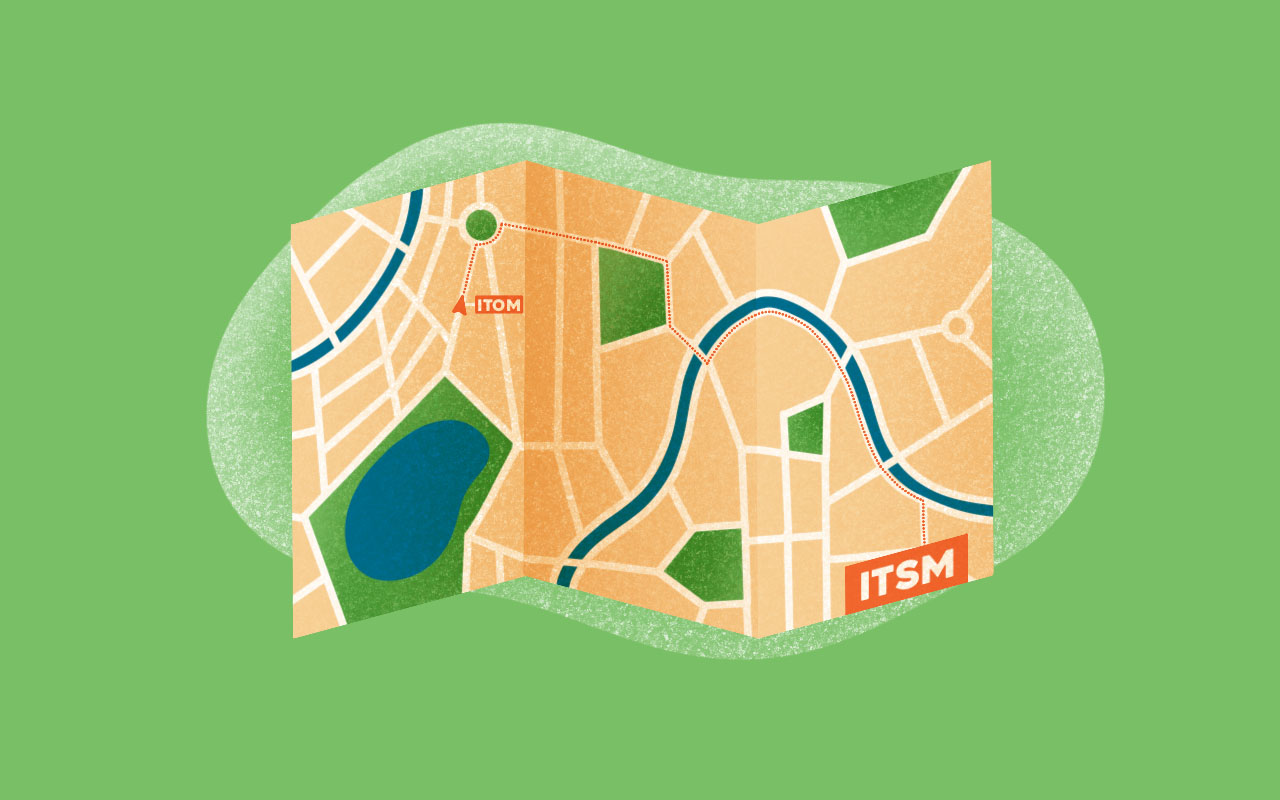
ITOM differs from ITSM in a few key ways:
|
ITOM |
ITSM |
|---|---|
|
Focused on tools, technical environment, and infrastructure that supports service delivery |
More customer-centric, focused on designing and delivering IT services to end users |
|
Broader operational scope encompassing the full infrastructure layer |
A subset of the ITIL service lifecycle, focused on service design, transition, and operation |
|
Manages the underlying technical environment that ITSM services depend on |
Manages the service experience built on top of that environment |
|
Includes event management and infrastructure monitoring |
Includes event management and incident, change, and problem management processes |
In mature IT organizations, ITOM and ITSM are tightly integrated — ITOM data (events, alerts, infrastructure health) feeds directly into ITSM workflows (incident creation, change impact analysis, problem identification), creating a closed loop between operations and service delivery.
Finally, it’s prudent to note that ITOM includes access to systems that allow for remote entry.
Key Benefits of ITOM: What IT Leaders Actually Gain
There are significant operational and financial benefits when it comes to integrating ITOM and ITSM. The following breaks down what those benefits look like in practice — and why they matter to IT leaders managing cost pressure and service quality simultaneously.
Improved Infrastructure Visibility and Observability
ITOM tools provide real-time monitoring dashboards and event correlation capabilities that surface infrastructure anomalies before they become incidents. This means IT teams gain a continuous, accurate view of network health, server performance, application availability, and cloud resource utilization – reducing mean time to detect (MTTD) and enabling faster, more informed decision-making across operations and service management teams.
Reduced Unplanned Downtime
Unplanned downtime is one of the most significant and underestimated cost drivers in IT operations. Proactive monitoring and event correlation allow ITOM to identify and address potential failures before they escalate into service outages. The operational impact of integrated ITOM and ITSM is well-documented: organizations that combine ITOM, ITSM, and AIOps (Artificial Intelligence for IT Operations) capabilities report approximately 20% fewer IT-related incidents and problems — a direct reduction in service desk load and the associated resolution costs.
Faster Incident Detection and Resolution
When ITOM and ITSM share a common data model, infrastructure events can automatically trigger incident workflows with full context — affected configuration items (CIs), related services, historical performance data — already attached. This reduces mean time to resolve (MTTR) by eliminating the manual triage and data-gathering steps that slow down incident response. The result is faster resolution, lower cost-per-incident, and less business disruption.
Better Resource Utilization and Capacity Planning
Accurate asset discovery and dependency mapping — core ITOM capabilities — eliminate shadow IT and over-provisioned resources, directly reducing licensing and infrastructure spend. Capacity management functions within ITOM allow IT teams to align resource allocation with actual demand, avoiding both under-provisioning (which causes performance issues) and over-provisioning (which wastes budget).
Support for Regulatory Compliance
ITOM provides the configuration management and audit trail capabilities that regulated industries require. A well-maintained Configuration Management Database (CMDB), continuously updated through automated discovery, gives compliance teams accurate records of what assets exist, how they are configured, and how they relate to business services — reducing the manual effort and risk associated with audit preparation.
The operational impact of integrated ITOM and ITSM compounds over time. Organizations that combine ITOM, ITSM, and AIOps capabilities report up to a 24% increase in agent productivity — not because agents work harder, but because they spend less time on avoidable incidents and manual triage. And when automation is layered in, IT organizations have reported cost reductions of up to 50% — though that figure reflects mature implementations with strong process discipline and clean underlying data, not out-of-the-box deployments. The point isn’t to promise a specific number. It’s to recognize that the efficiency gains are structural — they compound over time as your ITOM maturity improves.
All in, integrated ITOM and ITSM help the IT service desk shift from being a cost-center to a value center. When all IT services, from endpoint management to simple ticketing and knowledge management, are streamlined and organized well, you can increase agent productivity and satisfaction of both employees and customers. Integrated ITOM and ITSM work together to optimize costs.
ITOM Cost Benefit Analysis
If you still need convincing, there’s an analysis you can complete.
To start, businesses can look at the following inputs to build a cost-benefit case for their ITSM and ITOM investment:
-
Average cost-per-ticket: The baseline cost of handling each incident or service request through your current service desk.
-
Number of tickets reduced or deflected: The volume of incidents prevented or resolved through self-service and automation, reducing service desk load.
-
Cost of unplanned downtime: Calculated as hours of downtime × number of affected employees × average hourly productivity value, plus customer impact costs.
-
Productivity gain: The percentage improvement in agent efficiency resulting from automated triage, better tooling, and reduced incident volume.
A simplified ROI formula: ROI = (Cost savings from reduced tickets + Downtime cost avoided + Productivity value gained) − Cost of ITOM/ITSM solution.
Unplanned downtime costs also include the impact on affected customers and their perception of the company after dealing with a lengthy outage. Consider a documented scenario: during a system outage, help desk employees are flooded with customer requests, blocking their normal workflow. This creates a ticket backlog that delays resolution for all users. Customers experiencing the outage may abandon the service entirely. Prolonged or repeated outages damage brand reputation and accelerate customer churn — costs that extend well beyond the IT team’s budget line.
Calculating the ROI of ITOM requires more than a cost-per-ticket formula. The most meaningful inputs — avoided downtime costs, productivity recovered through automation, incident volume reduction — vary significantly by organization size, infrastructure complexity, and current process maturity. If you’re at the stage of building a business case for ITOM investment, a structured assessment of your current operational gaps is usually the most useful starting point. That’s where the real cost drivers become visible. Chat with one of our team members today.
AIOps and Automation in ITOM: Moving from Reactive to Proactive IT Operations
AIOps (Artificial Intelligence for IT Operations) is best understood as the intelligence layer that sits on top of ITOM data. ITOM generates enormous volumes of operational data — events, alerts, performance metrics, log data — that are impossible for human operators to process at scale. AIOps applies machine learning and analytics to this data to identify patterns, correlate related events, predict failures before they occur, and recommend or trigger automated remediation actions.
In practice, this means fewer false-positive alerts, faster root cause identification, and a measurable reduction in MTTR (Mean Time to Resolve). Specific capabilities include:
-
Event correlation and noise reduction: AIOps filters and groups related alerts, reducing alert fatigue and helping operations teams focus on what actually matters.
-
Predictive analytics for incident prevention: Machine learning models identify patterns in infrastructure performance data that precede failures, enabling intervention before users are impacted.
-
Automated remediation workflows: When a known issue pattern is detected, automated workflows can trigger resolution actions — restarting services, reallocating resources, or escalating with full context — without waiting for human intervention.
-
Closed-loop ITSM integration: AIOps feeds directly into ITSM incident and problem management workflows, ensuring that operational intelligence translates into structured service management actions.
The important caveat: AIOps is only as good as the data it receives. Organizations with fragmented monitoring tools, poor asset data, or siloed ITOM and ITSM platforms will struggle to realize AIOps value — the foundational data quality and integration work must come first.
The organizations that get the most from ITOM aren’t necessarily the ones with the most sophisticated tools — they’re the ones that have connected their operational data to their service management workflows and built the process discipline to act on it. If you’re evaluating whether your current ITSM and ITOM setup is positioned to deliver that kind of operational efficiency, it’s worth examining where the gaps actually are before investing in new tooling.