In the modern IT landscape, SLAs, XLAs, and OLAs represent far more than simple acronyms. They are the fundamental coordinates for navigating an increasingly demanding digital ecosystem – one where artificial intelligence and automation are reshaping every corner of IT governance.
So, the crucial question is this: how should these agreements be rethought in the age of AI?
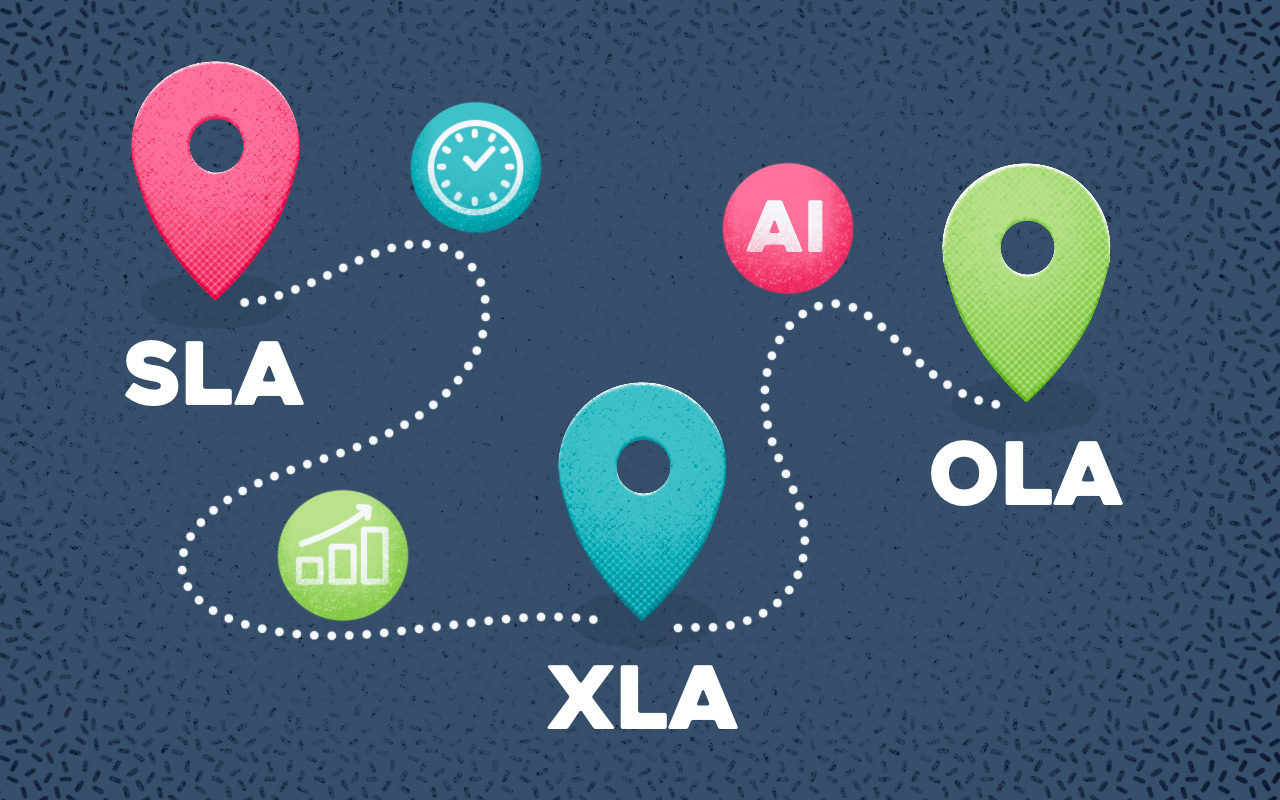
Let’s put it in a metaphor: they must be reimagined as a GPS for service quality.
Let’s continue with the example. Imagine having to drive through a city whose layout is constantly changing. Traditional maps are no longer enough – you need a real-time GPS capable of adapting to the ever-evolving topography.
That’s exactly what SLAs, XLAs, and OLAs are within the IT ecosystem; and AI integration is what allows the maps to update in real time, reacting proactively to change.
In this article, we will focus on the impact of AI on SLAs, XLAs, and OLAs.
But first, let’s bring some order to the topic.
SLA, XLA, OLA: Definitions and Key Differences
Let’s begin from the definitions, drawing clear boundaries between the different service agreements.
- SLA (Service Level Agreement): These are formal agreements between provider and customer that define the minimum guaranteed performance levels. They establish clear, measurable expectations.
- XLA (Experience Level Agreement): Here we go beyond technical parameters, focusing on the user’s lived experience and incorporating metrics related to satisfaction, perceived effort, and the quality of interaction with IT services.
We explored the growing importance of XLAs in this article: XLAs for 2026: The 5 Experience Metrics CIOs Should Monitor. - OLA (Operational Level Agreement): These focus on the relationships between internal teams and external providers who collaborate to ensure SLAs are met. They define responsibilities and operational timelines among the parties involved.
Traditionally, these agreements have been structured as rigid, static contracts. But today, with artificial intelligence, cloud scalability, and dynamic architectures, they must be completely rethought.
SLAs, XLAs, and OLAs now form an interconnected ecosystem that requires deep updating. It’s no longer just about defining standards or minimum service levels—it’s about building an infrastructure of trust, flexibility, and adaptability.
And this is where the challenges of the AI Era begin. Let’s analyze them below, focusing on the three different fronts.
The Evolution of SLAs: Toward Adaptive KPIs
With artificial intelligence and machine learning, performance metrics can no longer remain rigid. A well-implemented AI system can (and must) learn from user behaviors and adapt service levels more flexibly, based on real context.
Some examples?
- Uptime can be recalibrated by considering not just the raw availability data, but above all its concrete impact on business operations. To be specific: five minutes of downtime on a marginally used internal application carries a very different weight compared to a service outage on an e-commerce platform in the middle of Black Friday. AI enables this contextualization, automatically classifying criticality based on timing and the type of impacted service.
- Average response time, once a fixed metric with standard thresholds, can now be adjusted in real time according to workload, emerging priorities, and user habits.
- Alerts, finally, should no longer be treated as indistinct signals requiring manual analysis. Thanks to machine learning, advanced filtering mechanisms can be applied, automatically assigning priority based on criticality, predicted impact, and historical patterns. This not only reduces the informational noise that often paralyzes teams but also enables smarter and timelier escalation of truly urgent interventions.
AI and XLAs: Experience Becomes Increasingly Measurable
Along the continuum that runs from automated technical KPIs to predictive intelligence, user experience metrics play a crucial role. Because while it’s true that an IT system must function, it’s even more true that it must do so in a way that aligns with user expectations and perceptions.
Indicators such as Net Promoter Score, Customer Satisfaction Score, or User Effort Score are no longer just numbers to be reviewed in a report—they become real-time thermometers of service health.
This, in short, is the critical shift from SLA to XLA. And where can AI make an impact in this context?
In many ways. But we can group them into three main areas:
Continuous Feedback Collection
The first step in truly placing user experience at the center of IT processes is listening. Not passively, but through a structured strategy of continuous listening.
This may mean, for example, adopting intelligent chatbots capable of collecting impressions in real time, sending contextual surveys after service delivery, and leveraging sentiment analysis tools that examine comments, tickets, or interactions across digital channels.
All of this provides a multifaceted and constantly updated picture of user sentiment, rather than relying solely on quarterly or sporadic surveys.
Correlating Experience with Technical Data
The true power of the AI XLA approach lies in its ability to connect subjective data (perception) with objective data (technical metrics).
For example, analyzing to what extent a drop in satisfaction coincides with increased response times or a higher incidence of system errors.
Identifying recurring patterns enables teams to understand which technical aspects most significantly impact experience—and therefore to act in a targeted and timely manner.
Proactive Action
The final stage in the evolution toward experience-driven management is predictive capability.
AI can detect weak signals—spikes in requests, performance drops, anomalies—that precede a deterioration in user experience. In this way, it can suggest or automatically trigger improvement and corrective actions before the problem is even perceived by the user.
This not only increases satisfaction but also strengthens trust in the service and reduces pressure on support teams.
Rethinking OLAs: Distributed and Transparent Responsibilities
After redefining technical metrics (SLAs) and placing experiential ones (XLAs) at the center, it becomes inevitable to look inside the operational engine to understand how to truly make these agreements work.
This is where OLAs come into play.
In the AI era, it’s no longer enough for each team to simply perform its own task: coordinated and continuous collaboration is required—collaboration capable of adapting to change. OLAs thus become the operational glue that ensures consistency between the promises made to customers and operational reality. But for this to happen, they must be deeply rethought.
How?
By building three fundamental pillars.
- Roles and responsibility flows: Every IT activity involves multiple actors, internal and external. OLAs must clearly map who does what, when, and at which internal service level. This clarity is essential to avoid gray areas and bottlenecks.
- Organizational dynamism: Artificial intelligence makes it possible to dynamically reallocate resources according to priorities. OLAs must therefore be designed as flexible frameworks, automatically updated based on real conditions.
- Shared transparency: Real-time dashboards, metrics visible to everyone, continuous alignment. Today, the effectiveness of an OLA is also measured by its ability to facilitate distributed and shared governance.
Governance, Automation, and Sustainability
Designing advanced SLAs, XLAs, and OLAs integrated with AI ultimately means building a new culture of IT governance.
A culture founded on reliable data, cross-functional collaboration, and intelligent tools. A culture based on hybrid KPIs that consider the user’s voice, business context, and the real impact of service disruptions.
It also requires continuous agreement review: no longer annual or purely reactive updates but living maintenance of agreements. With AI, it is possible to detect pattern changes and anticipate critical moments.
The ultimate goal is sustainable efficiency. Because automation doesn’t simply mean doing more—it means doing it better.
Conclusions
Adopting AI XLAs is not a matter of trend or branding—it is a necessary step for any organization that wants to maintain high standards in a constantly changing world.
Redesigning SLAs, XLAs, and OLAs means redefining the very foundations of IT services, making it more intelligent, experience-centered, and data-driven.
FAQ
How is AI integrated into IT governance?
Through predictive analytics, intelligent event prioritization, and automated insight generation, enabling fast, data-driven decisions.
What are AI XLAs?
They are Experience Level Agreements designed with the support of artificial intelligence tools to measure, predict, and improve user experience in real time.
What is the role of tools like EV Observe in managing service agreements?
It provides proactive monitoring of performance and critical events, helping to meet SLAs and improve the user experience associated with XLAs.
A guide to AI in ITSM
Discover how to integrate artificial intelligence into your ITSM, redesign your processes, and take your company’s efficiency to the next level.